
The Limiting Belief Hiding Behind Every Burned-Out Executive
Share on:
About this Podcast
StartFragment
A senior executive sat across from Anadel Alberti and said the words most leaders only think privately. "It's just that I don't trust them." Anadel asked one question back. "Do you trust yourself in the work that you're doing?" The room went quiet. The executive did not answer for a long time.
That single exchange contains the spine of two decades of executive coaching, three certifications across wellness, stress management, and executive development, and one company built on the premise that human-centered leadership has gone quietly missing inside organizations of every size. The teams feel it. The culture absorbs it. And the ROI on every other initiative bleeds out before anyone notices.
In this episode of the Legacy and Longevity Podcast with host Zach Dancel, Anadel explains how she spent the first half of her career adapting to other people's expectations, lost herself in the process, and rebuilt a coaching practice on the principle that authenticity is the only sustainable leadership infrastructure.
What this episode teaches in plain terms: the executives most likely to burn out their teams are the ones who stopped trusting themselves first. Every leadership dysfunction downstream of that point is a symptom, not the disease.
Lesson one: The limiting belief running underneath everything
Anadel names the single belief that quietly drives most executive failure. Not enough. She carried it for years. She watched it pretend to be confidence in boardrooms, decisiveness in meetings, and authority in conversations she did not actually want to be in. The belief never announced itself. It operated as a background process, shaping every decision before the executive consciously made it.
Most leadership programs do not treat this. They train technical skills, communication frameworks, and management methodologies. They do not address the internal narrative running inside the leader who has to apply any of it. The result is executives who execute the methodology while the limiting belief silently degrades every output. The team feels something is off. They cannot name it. They start protecting themselves emotionally. Trust breaks. The culture absorbs the damage.
Lesson two: The trust cycle that breaks at the top
Most executives blame their teams for trust failures. Anadel's coaching reverses the diagnosis. When a leader does not trust themselves, they cannot extend trust outward. They micromanage. They refuse to delegate. They double-check work that does not need double-checking. The team reads every behavior as evidence that the leader does not believe in them, and they respond by disengaging or pretending. The executive sees the disengagement, interprets it as proof that the team cannot be trusted, and tightens the grip further. The cycle compounds.
The intervention is not a team-building offsite. It is asking the leader the question Anadel asked her client. Do you trust yourself in the work that you're doing? The answer is almost always no, with explanations attached. The explanations are the work. Once the explanations are surfaced, the trust cycle has somewhere to start unwinding.
Lesson three: Where 73% of corporate investment goes wrong
Anadel cites a number that haunts most leadership development conversations. Roughly 73% of corporate training investment goes to technical skills. The remaining slice goes to soft skills, often as a checkbox compliance line item rather than a real investment. The math punishes everyone involved. Companies that genuinely invest in their leaders' essential skills consistently outperform companies that do not on retention, engagement, productivity, and ultimately revenue. The data is not contested. The investment patterns are.
The reason the imbalance persists is that technical skills feel measurable and soft skills feel squishy. Anadel's coaching practice exists in part to challenge that assumption. She works with leadership teams using diagnostic testing, psychometric evaluations, and structured insights interviews to make the soft work measurable. The result is a framework that connects authenticity, trust, and human-centered leadership directly to organizational performance metrics. The "squishy" work becomes auditable. The skeptical CFO becomes a believer.
Lesson four: The lone vision problem
When asked to name the single piece of traditional leadership advice doing the most damage today, Anadel's answer arrived without a pause. The belief that the visionary is the only one who can hold the vision. That belief turns founders into bottlenecks. It convinces them that no one else cares enough, sees clearly enough, or works hard enough to be trusted with the bigger picture. The result is a leader who cannot delegate the strategic work and cannot accept help on the execution work, which leaves them doing both and resenting the team for not doing more.
The fix is not motivational. It is structural. The vision has to be communicated, lived, and absorbed by every layer of the organization until people on the front line can articulate it in their own words. Companies that do this multiply the message. Companies that do not watch the founder slowly burn out while the team waits for instructions.
Lesson five: The audacious shift that costs nothing
When Zach asked Anadel what one shift every burned-out executive could make tomorrow morning, her answer was a single word. Listen. Most leaders default to directing. They tell, instruct, and correct. They confuse the volume of their voice with the strength of their leadership. Anadel's framework asks them to do something most have not practiced since they were promoted. Stop directing. Start listening. Ask the people closest to the work what is actually happening, and let the answer change something.
The shift is audacious because it costs the leader the protective layer of authority. It requires admitting that the team might know things the executive does not. It requires sitting with information that contradicts the leader's preferred story. It requires changing course based on what gets heard. Most executives refuse to make this shift. The ones who do find that the trust cycle they have been struggling to fix starts repairing itself without further intervention.
FAQ
Why is authenticity treated as soft when it produces hard results?
Most organizational metrics were designed to track outputs that are easy to measure and easy to defend in a board meeting. Authenticity does not show up on a quarterly report. The downstream effects of authenticity, including trust, retention, engagement, and culture quality, all show up eventually but are hard to attribute to the original cause. The misalignment between what is measurable and what is consequential is the reason authenticity gets coded as soft.
What separates a leader from someone with a leadership title?
The title is granted. Leadership is practiced. The daily choice to listen instead of direct, to extend trust before demanding it, and to make space for the team to hold the vision alongside the founder is what separates the two. Anyone with a title can avoid those choices. Leaders make them when no one is watching.
Why does personal life baggage show up at work even when leaders try to compartmentalize?
The internal operating system runs across both. The same belief patterns, communication habits, and emotional defaults that shape personal relationships shape professional ones. Boundaries can prevent specific issues from leaking through, but the underlying patterns travel. Anadel's coaching addresses this directly because pretending the two domains are separate is part of how the dysfunction sustains itself.
How does an executive start trusting themselves again?
By naming the limiting belief that has been running quietly. By asking what evidence has actually been collected to support or contradict it. By making one small choice that would only feel right if the belief were untrue, and then noticing what happens. The work is not philosophical. It is iterative.
Listen to the full conversation on the Legacy and Longevity Podcast and subscribe for more episodes connecting health optimization, peak performance, and legacy building.
Burnout, low trust, and disengaged teams are not just leadership problems. They are biological ones. The chronic stress of leading without alignment shows up in the body before it shows up in the metrics. Nava Health helps high performers optimize the body behind the leadership. Start with a full picture of your health, click the link below:
Follow Legacy and Longevity Podcast:
Website: LegacyandLongevity.com | Facebook: Legacy-and-Longevity-Podcast | YouTube: @LegacyandLongevityPodcast | Instagram: @LegacyandLongevity
Follow Zach Dancel:
Instagram: @ZachDancel | Facebook: Zach.Dancel | LinkedIn: @ZachDancel
Follow Anadel Alberti:
LinkedIn: @AnadelAlberti | Website: Au2Movement.com
#LegacyAndLongevity #AnadelAlberti #AudaciouslyAuthentic #ExecutiveCoaching #Leadership #HumanCenteredLeadership #Authenticity #LeadershipDevelopment #NavaHealth #BurnoutPrevention #TrustInLeadership #TeamCulture #MindsetMatters #ZachDancel #HealthOptimization #ExecutiveHealth #LeadershipStrategy #TeamAlignment #OrganizationalWellbeing #PeakPerformance #HighPerformance #Resilience #PersonalDevelopment #CommunityMatters #LegacyBuilding #SoftSkills #CorporateCulture #WorkplaceWellness #NavaCenter #PersonalGrowth
EndFragment
Listen & Subscribe
Available on all major podcast platforms
 Spotify
 Apple
Apple
 Amazon Music
 Youtube
Recent Blogs
 Jun 23, 2026
Most people build careful plans for their careers, their businesses, and their retirement accounts,...
Read More Jun 16, 2026
Most people reach 40 and quietly start preparing for the slow fade. The dad bod, the brain fog, the...
Read More Jun 09, 2026
Dr. Hany Demian spent eight years in emergency medicine before pivoting into chronic pain, then agai...
Read More Jun 02, 2026
The long game of testosterone reaches further than libido and muscle. Those are the short-term wins,...
Read More May 26, 2026
For seven decades, the answer to "does testosterone cause heart attacks" was a reflexive yes. Doctor...
Read More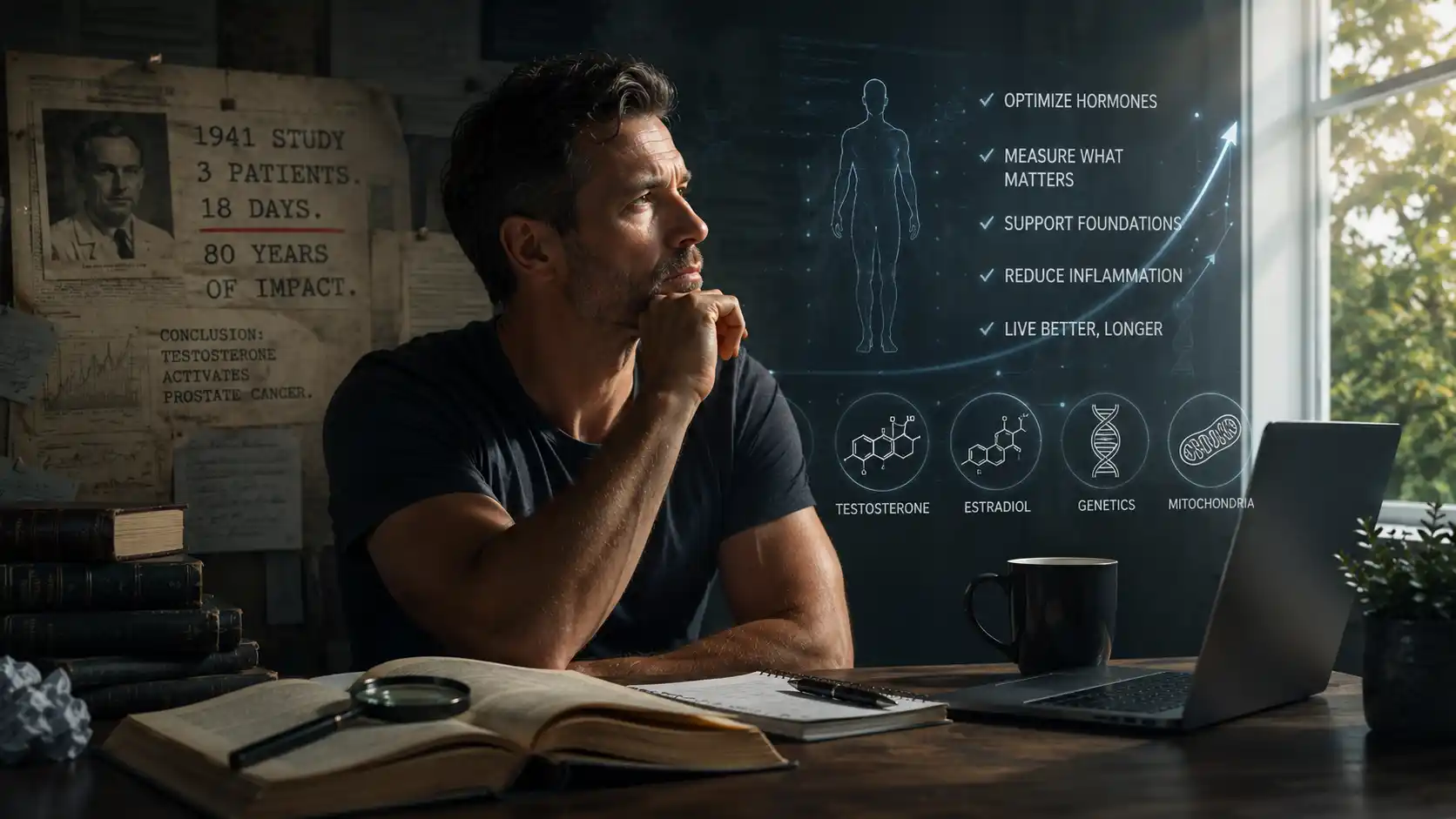 May 19, 2026
In 1941, a researcher named Charles Huggins published a paper on metastatic prostate cancer that wou...
Read More May 12, 2026
Cristhel Just spent two decades climbing the corporate ladder at Coca-Cola and IBM. MBA, accolades,...
Read More
May 05, 2026
A senior executive sat across from Anadel Alberti and said the words most leaders only think private...
Read More Apr 28, 2026
Adam Ficsor built the only Bitcoin wallet in the world capable of making transactions fully private....
Read More Apr 21, 2026
Dr. Tabatha Russell did not start with a safety net. She grew up in inner city Philadelphia, riding...
Read More
Comments