
Why Women Have Zero FDA-Approved Testosterone Options
Share on:
About this Podcast
Part 2 of 2 | Part 1 covered the Women's Health Initiative and estrogen therapy. This episode exposes testosterone deficiency, birth control impact, and the pharmaceutical industry's financial interest in keeping women sick.
Start with Part 1: What If Everything You Were Told About Hormone Therapy Was Wrong? The Data That Changes Everything - Begin with the Women's Health Initiative breakdown, estrogen therapy, and the timing hypothesis before diving into testosterone.
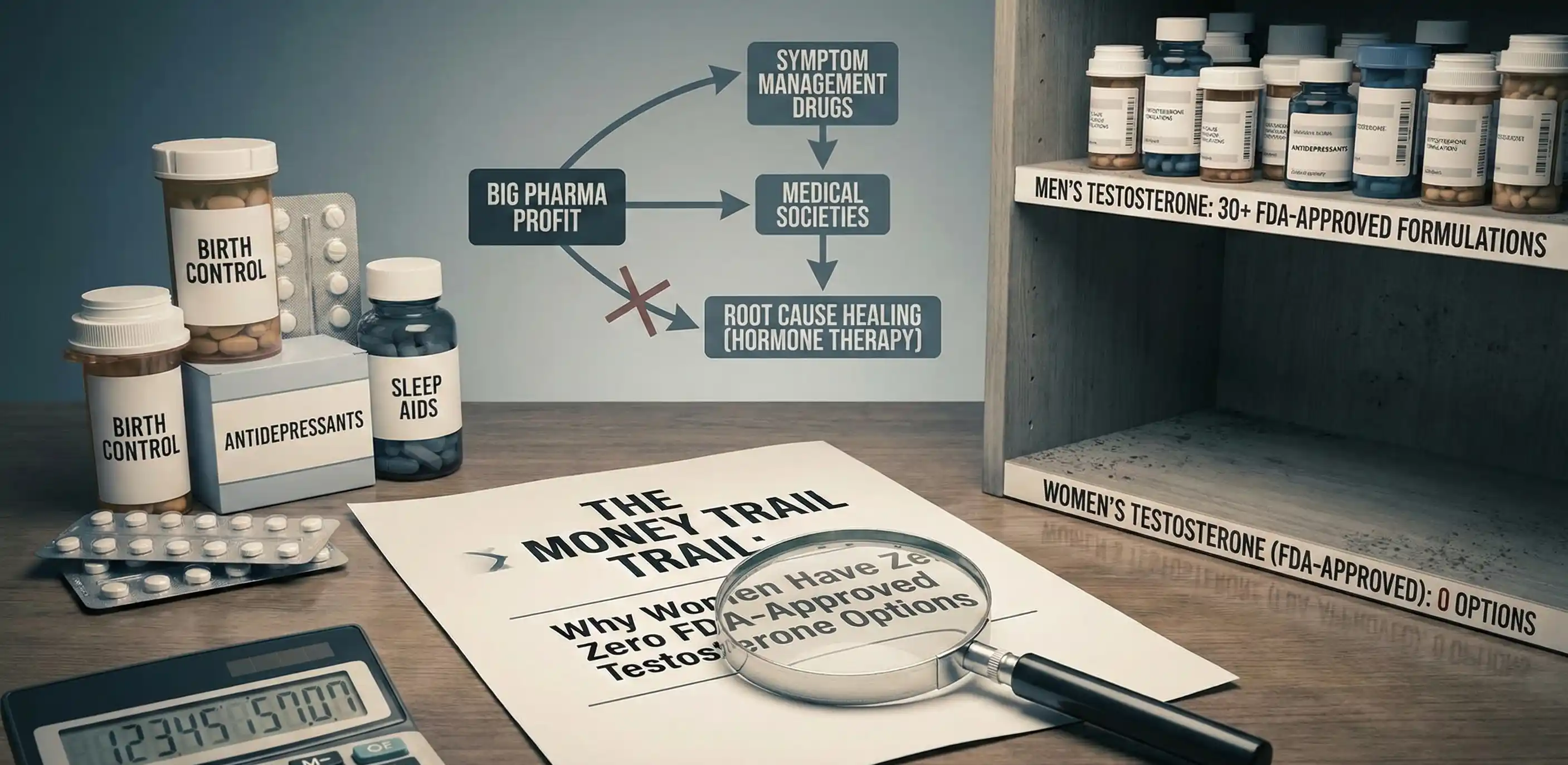
Testosterone is the most abundant sex hormone in women. Not estrogen. Most women don't know this because conventional medicine doesn't discuss it. Men have over 30 FDA-approved testosterone formulations. Women have zero. That's not an accident. That's a business decision protecting a 300 billion dollar annual pharmaceutical industry built on symptom management instead of root cause healing.
In Part 2 of the Legacy and Longevity Podcast, COO Zach Dancel and Clinical Director Stephanie Misanik expose how birth control depletes testosterone starting at age 14, why doctors misdiagnose hormone deficiency as ADHD and depression, and how pellet therapy delivers superior outcomes compared to creams and injections. This conversation follows the money trail proving that curing women through hormone replacement therapy threatens antidepressant, anxiety medication, sleep aid, osteoporosis drug, and metabolic medication industries that profit from keeping women on symptom management drugs for decades. Part 1 covered estrogen and the Women's Health Initiative. This episode completes the picture by revealing the hormone nobody talks about despite it being more abundant than estrogen in women.
Testosterone Is The Most Abundant Female Hormone
Women produce three to four times more testosterone than estrogen naturally. That fact shocks most people because testosterone gets labeled as the male hormone. But women need testosterone for metabolism, muscle building, brain function, sexual health, bone density, and inflammation control. Not discussing testosterone replacement for women constitutes medical malpractice, according to Stephanie Misanik.
Testosterone deficiency starts in the early thirties for most women, earlier than estrogen decline. Birth control depletes testosterone dramatically starting at age 14 when girls receive prescriptions for irregular or heavy periods. Research on oral contraceptives and androgen levels shows that combined hormonal contraceptives significantly reduce free testosterone levels and increase sex hormone binding globulin, which binds testosterone and makes it unavailable for use.
Women in their mid-thirties who have eaten poorly, consumed alcohol regularly, lived with chronic stress, and taken birth control since age 14 experience testosterone depletion much sooner than women who avoided those factors. But even women with excellent lifestyle habits face natural testosterone decline starting in early thirties that accelerates through perimenopause and menopause.
Birth Control Shuts Down Hormones Without Informed Consent
Birth control doesn't treat irregular periods or heavy bleeding. It shuts down the menstrual cycle completely. Girls as young as 11 and 12 receive prescriptions from OBGYNs without informed consent about long-term hormonal consequences. Neither the patient nor the parents receive education about testosterone depletion, estrogen suppression, progesterone elimination, or fertility impacts decades later.
These young girls never develop regular menstrual cycles because birth control shuts everything down from the beginning. They experience fits and starts with irregular periods but never establish the hormonal rhythm necessary for healthy reproduction later in life. Then in their late twenties or early thirties, they want to conceive. They stop taking birth control after 20 years and discover their bodies don't know how to produce hormones properly because the system never fully developed.
This is a massive contributor to the infertility crisis affecting women across developed nations. Birth control prescribed at age 11 or 12 for convenience or symptom suppression creates hormonal dysfunction that persists into the thirties and forties when women attempt pregnancy. Add environmental endocrine disruptors, processed food, sedentary lifestyle, chronic stress, and alcohol consumption, and the fertility challenges multiply exponentially.
Birth control depletes testosterone, estrogen, and progesterone while creating systemic inflammation because all birth control uses synthetic hormones. Synthetic molecules don't match natural hormone structure, which triggers inflammatory responses. Twenty years of low-grade inflammation from synthetic hormones plus nutrient depletion compounds the damage that emerges when women try to conceive or enter perimenopause.
Testosterone Drives Metabolism And Prevents Diabetes
Testosterone directly impacts glucose metabolism by improving insulin sensitivity and helping cells take sugar from food and convert it into energy. When testosterone drops in early thirties, HbA1c starts creeping upward. That marker measures average blood sugar over three months. Women who maintained 5.0 HbA1c levels in their twenties suddenly see 5.2, then 5.3, then 5.5 in their mid-thirties.
Conventional medicine doesn't intervene until you're diabetic. Doctors tell women to exercise more and eat less without addressing the testosterone deficiency causing glucose dysregulation. Blood sugar dysregulation is one of the most inflammatory processes in the body. When blood sugar swings up and down repeatedly without proper regulation, it creates oxidative stress, inflammation, and eventual insulin resistance that leads to diabetes, obesity, and cancer.
Women in their forties endlessly walk on treadmills wondering why they can't build muscle or lose belly fat. They don't have enough testosterone to build lean muscle mass regardless of exercise volume. Research on testosterone and body composition in women confirms that testosterone therapy improves lean body mass, reduces fat mass, and enhances insulin sensitivity in postmenopausal women.
Lean muscle mass is the single biggest predictor of longevity. Without testosterone, women cannot build or maintain muscle effectively. Cardiovascular exercise alone won't solve the problem. Strength training requires testosterone to produce results. This is why women need testosterone replacement just like men when levels drop below optimal ranges.
Sexual Health And Relationship Destruction
How many couples divorce in their forties and fifties? Testosterone loss is a significant contributing factor that nobody discusses. Men maintain sex drive regardless of age. Women lose libido completely when testosterone drops. Sexual connection deteriorates. Relationships fall apart because the physical intimacy that bonded the couple disappears.
Low testosterone eliminates desire, reduces orgasm intensity, and prevents arousal. Combined with estrogen deficiency causing vaginal dryness and painful intercourse, women in their forties and fifties lose all interest in sex. That's not a moral failing or relationship problem. That's biochemistry. Hormone replacement therapy restores sexual function, desire, and connection that sustains long-term relationships.
Pellet Therapy Delivers Superior Results
The gold standard for hormone replacement therapy is pellet therapy. Creams absorb 20 to 30% at best and require daily application with site rotation to prevent receptor saturation. Transfer risk exists when touching children or partners after application. Pellets provide nearly 100% bioavailability with steady hormone release over three to six months.
The procedure involves local numbing and a small incision in the gluteal area where a trocar places testosterone and estrogen pellets into subcutaneous tissue. The pellets sit where ovaries naturally produce hormones. As blood passes by, it picks up hormones as needed and distributes them systemically. No stitches required. Avoid heavy lifting and baths for a few days. That's it.
Providers who fear pellets don't understand proper dosing. Nava Health developed a proprietary dosing calculator after 12 years treating over 60,000 patients and administering over 100,000 pellet procedures. The calculator accounts for lifestyle factors, medical history, body composition, and lab markers to determine precise individualized dosing.
Serum testosterone levels don't tell the complete story. That number reveals what's in the bloodstream, not what's actually getting into cells and being used functionally. Providers who only look at serum levels and try to fit everyone into lab reference ranges don't understand hormone optimization. Reference ranges represent the general population where 95% are metabolically unhealthy and 70% are overweight or obese. Optimal ranges differ significantly from normal ranges.
Nava Health monitors labs every four months post-pellet but also evaluates symptoms comprehensively. Are you building muscle? Is your mood improving? Is your libido returning? Are you losing belly fat? Is brain fog clearing? Those outcomes matter more than fitting into a reference range designed for a sick population.
Follow The Money Trail
Why did it take 23 years to remove the black box warning from menopausal hormone therapy? Why do men have 30 FDA-approved testosterone formulations while women have zero? Follow the money. Hormone replacement therapy fixes root causes. That threatens the pharmaceutical industry built on symptom management.
Antidepressants generate 18 to 25 billion dollars annually with over 250 million prescriptions despite only 15% of users reporting improvement. Estrogen therapy alone reduces depression risk by 60% for early adopters. But curing depression through hormone optimization eliminates antidepressant sales.
Anxiety medications generate 15 billion dollars annually with nearly 100 million prescriptions. Benzodiazepines like Xanax are highly addictive with fatal withdrawal risk and rebound anxiety as a primary side effect. Estrogen and progesterone balance eliminates anxiety for most women experiencing hormone-related symptoms. But curing anxiety eliminates benzodiazepine sales.
Sleep medications generate 5 to 8 billion dollars annually with 20 to 30 million prescriptions. Hormone optimization restores natural sleep architecture without pharmaceutical intervention. But curing sleep disorders eliminates sleep medication sales.
Osteoporosis drugs generate 12 to 15 billion dollars annually. Estrogen and testosterone maintain bone density and reduce fracture risk by 30 to 50%. But preventing osteoporosis eliminates bisphosphonate sales. Those medications actually increase fracture risk long-term according to research on extended bisphosphonate use.
The pattern is clear. Hormone replacement therapy threatens antidepressants, anxiety medications, sleep aids, osteoporosis drugs, blood pressure medications, cholesterol drugs, GLP-1s, and every other pharmaceutical addressing downstream symptoms of hormone imbalance. That's 200 to 300 billion dollars annually at stake.
Big Pharma funds the medical societies that write treatment standards. The American College of Obstetricians and Gynecologists, the Endocrine Society, and other organizations receive pharmaceutical funding and create protocols that prioritize symptom management over root cause healing. Doctors follow those protocols because that's what medical education teaches and insurance companies reimburse.
Find Providers With Expertise Not Just Prescriptions
Telemedicine platforms offering 15-minute consultations and hormone prescriptions without comprehensive evaluation create dangerous situations. You cannot assess hormone status, metabolic health, cardiovascular risk, nutrient status, thyroid function, and detoxification capacity in 15 minutes. Providers doing so don't understand hormone optimization complexity.
Not all doctors know hormones. Most endocrinologists are not hormone experts. Most OBGYNs received surgical training, not hormone management education. Finding a provider with true expertise requires research. Look for practitioners who trained outside medical school through functional medicine organizations and have years of experience managing thousands of patients.
Nava Health providers trained extensively with hormone experts who have 70 to 80 years combined experience. They work from evidence-based protocols developed over 12 years treating 60,000 clients. They monitor labs every four months. They evaluate symptoms comprehensively. They understand hormone metabolism, detoxification pathways, and why thyroid must be addressed alongside sex hormones. They don't just shoot for a number on a lab panel.
The Abundant Hormone
Testosterone is the most abundant sex hormone in women and critically important for metabolism, muscle building, brain function, sexual health, and bone density. Men have over 30 FDA-approved testosterone options. Women have zero because curing women through hormone therapy threatens the 200 to 300 billion dollar pharmaceutical industry built on symptom management. Birth control depletes testosterone starting at age 14 without informed consent, contributing to infertility decades later.
If you're a woman experiencing unexplained weight gain, inability to build muscle, brain fog, low libido, or mood disturbances, testosterone deficiency is more likely than ADHD or depression. Find a functional medicine provider with hormone expertise who monitors comprehensively and treats root causes instead of managing symptoms. Subscribe to the Legacy and Longevity Podcast and share this information with women who deserve access to life-changing therapy.
Follow Legacy and Longevity Podcast:
Website: LegacyandLongevity.com | Facebook: Legacy-and-Longevity-Podcast | YouTube: @LegacyandLongevityPodcast | Instagram: @LegacyandLongevity
Follow Zach Dancel:
Instagram: @ZachDancel | Facebook: Zach.Dancel | LinkedIn: @ZachDancel
Follow Stephanie Misanik:
LinkedIn: @SMHHC
Listen & Subscribe
Available on all major podcast platforms
 Spotify
 Apple
Apple
 Amazon Music
 Youtube
Recent Blogs
 Dec 09, 2025
Richard Blake made it to the top of his field. PhD-trained psychologist. Published researcher. Breat...
Read More
Dec 02, 2025
Part 2 of 2 | Part 1 covered the Women's Health Initiative and estrogen therapy. This episode expose...
Read More Nov 25, 2025
Part 1 of 2: This episode breaks down the Women's Health Initiative study and why early estrogen int...
Read More Nov 18, 2025
Lauren Sambataro made it to Broadway. One to two percent of performers ever reach that stage. She da...
Read More Nov 11, 2025
Jessica Ernst answered the door to find her husband Rudy barely conscious. Seven days later, he was...
Read More Nov 04, 2025
Executives spend thousands on Oura rings, Eight Sleep mattresses, and supplement stacks while ignori...
Read More Oct 28, 2025
Stephanie Misanik, MS, CNS, LDN didn't start her career in healthcare. She started it sick, anxious...
Read More Oct 21, 2025
Aleka Dancel spent her middle school years eating lunch in a bathroom stall. Not by choice, but beca...
Read More Oct 14, 2025
Zach Dancel's journey from the football field to the executive suite reads like two completely diffe...
Read More
Comments